Loading...
Build on retirement savers’ confidence by helping them keep emotions in check
Retirement savers feel better — but still react emotionally to market swings.
Our 2025 Protected Retirement survey of retirement plan participants and sponsors revealed some good news: Retirement savers are feeling more confident about their financial futures. But this higher confidence coincides with a daunting problem: Many participants are anxious about market volatility and are reacting emotionally with their retirement savings.
Plan sponsors can help boost retirement confidence by promoting access and education among plan participants, helping them avoid costly mistakes with their retirement savings.
Participants feel more confident, but are they too confident?
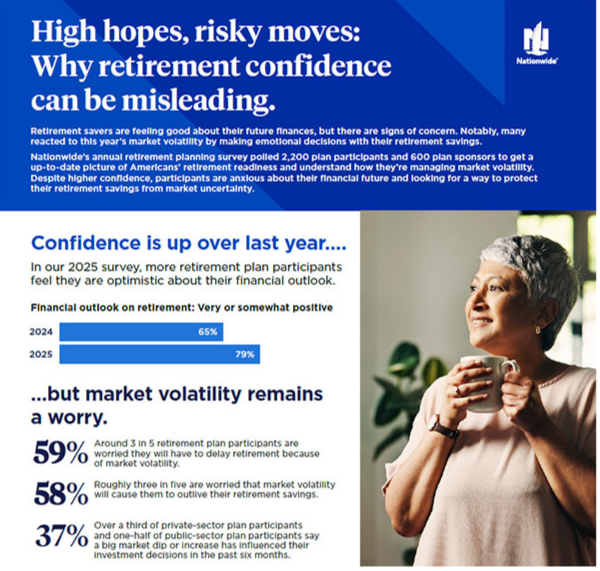
Let's continue with other good news from this year's survey: Plan participants are generally more positive about their financial outlooks for retirement — 79% said so in our 2025 survey, up 14 percentage points from the previous year. More participants also said their retirement preparations are on the right track — 71% in our recent survey, up 6 percentage points from 2024.
This rise in confidence is an encouraging sign for the financial futures of American workers. But higher confidence should be backed up by positive behaviors. On that point, many participants aren’t doing so well.
First, there’s a surprising lack of financial knowledge, which could erode confidence if it leads to poor decisions. In fact, fewer than half of retirement savers we surveyed (46%) understand how compound interest works — one of the foundational concepts in financial literacy.
Secondly, participants who express the highest levels of confidence are more likely to make decisions that could undermine their retirement readiness. They are 12 percentage points more likely to have reallocated savings to more conservative assets during times of volatility, potentially locking in losses. They are also 10 percentage points more likely to have made emotional decisions about their retirement investments that they ended up regretting.
The decisions that participants end up regretting the most — buying high, selling low, investing too much in a single investment or asset class and halting retirement contributions altogether — run counter to some of the foundational rules of investing.
One overarching insight to take from our survey: Feeling confident isn’t the same as being prepared. Your guidance can help savers build on the confidence they have by expanding their financial knowledge and reinforcing the principles of prudent financial planning.
Access the infographic
Market volatility stirs emotional reactions
It’s also good to see that retirement savers are feeling confident despite the financial market volatility we’ve experienced this year. As the turbulence intensified, participants appeared to engage more with their workplace retirement plans; 44% in our survey said they checked their account balances more frequently because of these market fluctuations.
But there’s always an emotional side to market volatility that investors and retirement planning professionals need to reckon with. Fear of investment losses in the short term can create anxiety over the long term, as workers question whether they could retire on time or whether their retirement savings will last as long as they need it.
Our survey found that 59% of retirement plan participants are worried that they’ll have to delay retirement because of market volatility. Nearly the same amount fear that market volatility will cause them to outlive their retirement savings.
In response to the ups and downs in the financial markets, nearly half of participants shifted their retirement savings to more conservative assets. This reaction might be expected for older workers, who may turn cautious with retirement just around the corner. But this behavior was also common among younger workers: 54% of participants ages 22 to 34 reacted to market volatility by moving their savings to more conservative investments.
That’s concerning because these retirement investors may be sacrificing long-term growth potential in search of short-term reassurance. But plan sponsors can help address these concerns over market volatility and uncertain retirement outcomes.
What’s most important to retirement savers
The anxieties that many workers have about their future finances became clear when we asked them what’s most important with their retirement savings. The overwhelming answer for 43% of plan participants was generating retirement income for life. Other goals such as strong investment performance or stable returns that are often considered valuable to retirement savers actually ranked in the single digits in terms of importance.
There’s a lot of interest among retirement plan participants for pension-like1 features that generate lifetime retirement income. Roughly 9 out of 10 participants wish their current employer-sponsored retirement plan offered solutions to provide a monthly source of income that would last for life.
What makes these options so appealing to today’s savers? The ability to generate lifetime income is a straightforward benefit, but what’s often missed is that these features offer protection from market volatility as well. Sticking with the “pension-like” analogy, the stream of income lasts for life and isn’t dependent on market conditions. Offering lifetime income solutions in a retirement plan can not only help solve participant concerns about running out of savings during their lifetime, it can also offer savers confidence during turbulent times to help them stay the course.
There's more good news: Many plans are already offering these features. Of those that don’t, around two-thirds of these employers say they’re open to considering these solutions.
Cost is the biggest barrier to wider adoption by these employers, but a majority of private-sector employees (85%) said they would be willing to pay more for an investment option that offers lifetime retirement income protection from market losses.
Employers want to help but need guidance
For employers, offering retirement plan solutions such as lifetime income funds is not just good for their employees, it’s good for their businesses too. These features can help strengthen employees’ retirement readiness, which can boost satisfaction and ease long-term financial pressures on the firm.
Retirement plan sponsors are central to solving the problem of retirement confidence, but it’s truly a team effort. Employers must evolve their retirement plans to include features that help savers overcome emotional investing, whether that’s offering online tools, personalized guidance, or funds that offer income that’s guaranteed for life. And employees need to stay engaged with their savings plans, learning and following the principles of prudent investing, even when the going gets tough.
With resources and solutions from Nationwide, you can be empowered to expand access and education, to help more American workers feel confident about achieving lifetime income security.
[1] This term refers to the similarity between Nationwide’s Protected Retirement income solutions and a traditional pension plan in the sense that both can provide a stream of income for participants’ lives. However, it’s important to note that these solutions are not pensions. The term “pension-like” is used solely to illustrate the income feature of the solutions and does not imply any other characteristics typically associated with pensions.
Edelman Data and Intelligence (DXI) conducted a national online 20-minute survey of n=500 private plan sponsors, n=100 public plan sponsors, and n=2,200 plan participants, on behalf of Nationwide from July 30 through Aug. 13, 2025.
As a member in good standing with The Insights Association as well as ESOMAR, Edelman Data and Intelligence conducts all research in accordance with local, national and international laws as well as in line with all Market Research Standards and Guidelines.